Designing and Managing the GIM
The implementation of a module like the GIM requires institutional commitment on many levels, given that a certain amount of resources ought to be allocated to its development and running. Here we understand resources on one hand in terms of funding and, on the other hand, in terms of the time that each of the different stakeholders will need to invest in order for the module to be successful.
The organization of the learning experience also requires careful planning and consensus‐reaching among the different stakeholders – mainly professors and educational innovation consultants – in order to design the learning process based on an agreed‐upon problem, as well as to find an assessment means that adequately evaluates students’ learning in an integrated way (that is, that the different knowledge areas feel the assessment architecture and rubrics effectively assess students’ application of the knowledge and competences acquired in their courses).
For maximum effectiveness to be reached the following stakeholders ought to be involved in the design and implementation of the Global Integrative Module:
- Academic programmes’ directorships.
- Department or centre responsible for educational innovation in the Business School.
- Team of professors from the different knowledge areas involved in the complex resolution of the problem.
- Information and Communication Technologies department.
- Project leading team in each of the participating Business Schools.
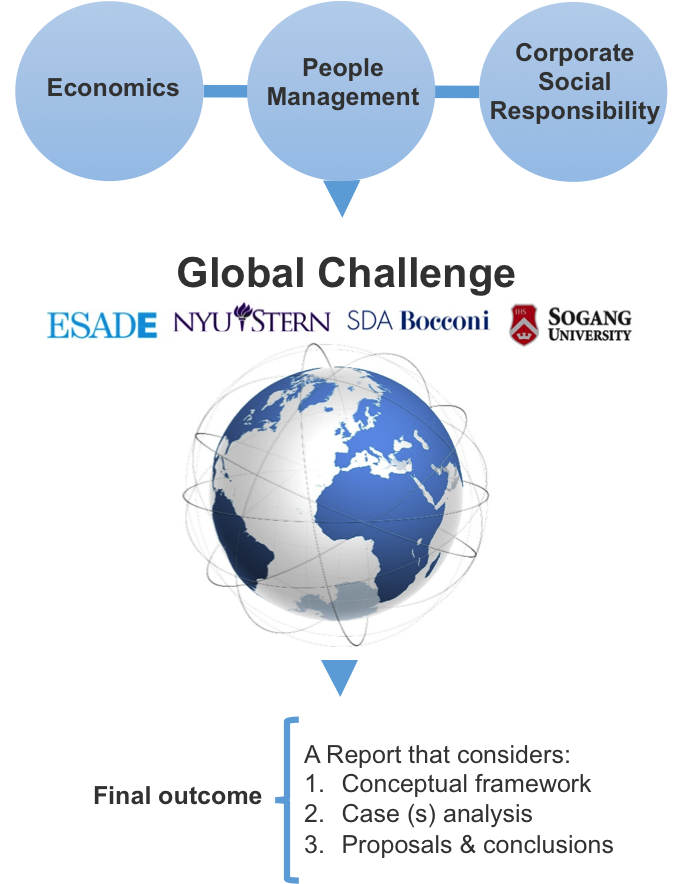
Figure 1. GIM Global Challenge