The Studio Pedagogy Approach
The studio pedagogy approach (e.g. Barry & Meisiek, 2014) has been applied to design the learning dynamics students will be engaged in to solve the challenge as well as the scaffolding tools that will be put at their disposal. Regarding the former, the experimental learning is based on collaborative dynamics where the different international teams will work on successive iterations on the deliverables required with the mentoring of a tutor and with the possibility to obtain further insight and guidance by the faculty involved as well as feedback from the other teams facilitated by the fact that students have access to other teams’ work.
On the other hand, regarding the scaffolding tools, a web-based ‘virtual studio’ environment has been designed to enhance shared knowledge-construction and problem-solving among the members of the international teams (see Appendix A figures 1.4 and 1.5). Students’ creativity, team-work and leadership skills are put into action as they will work in diverse teams. The use of the “virtual studio” aims to develop students’ competences to collaborate in the construction of a community of practice (simulation of professional consultancy situation), making the most out of the opportunities that learning environments put at their disposal.
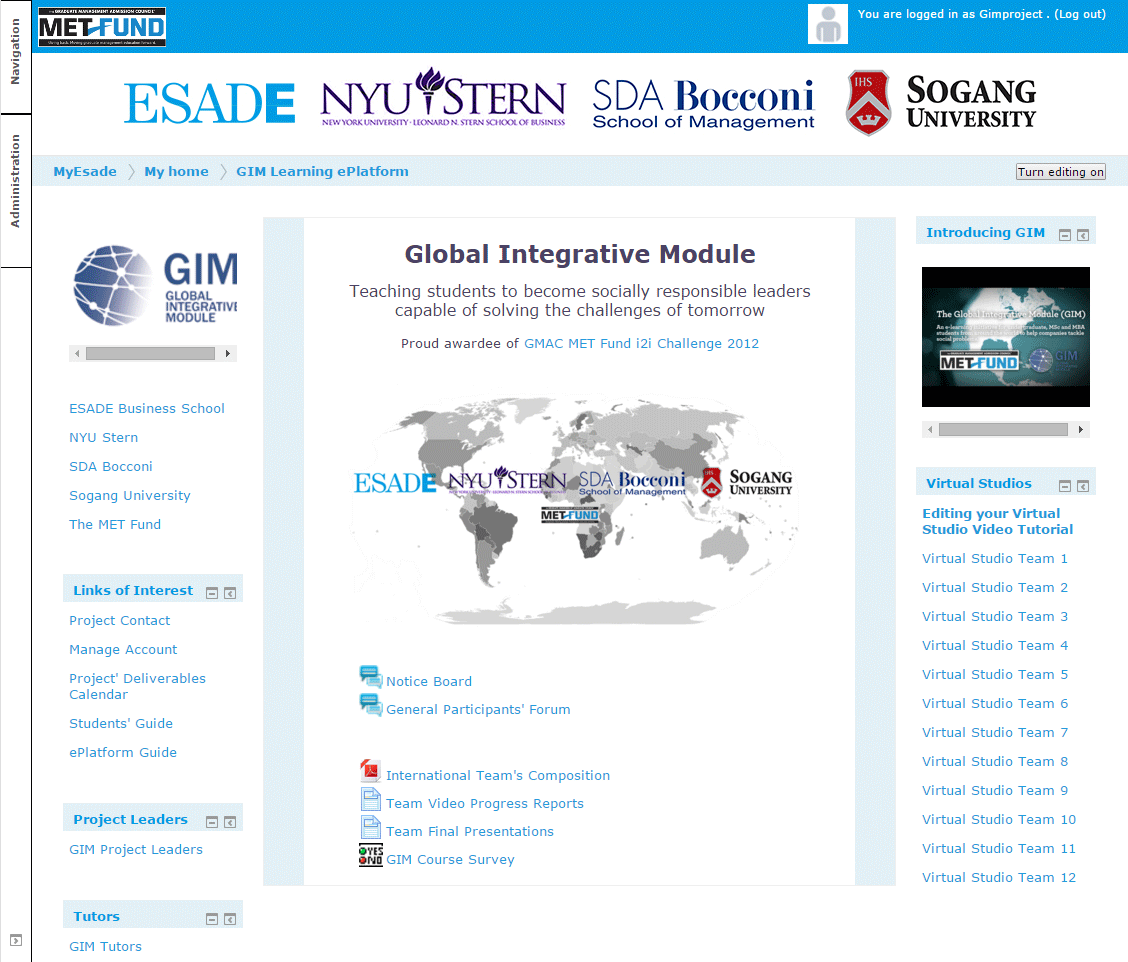
Appendix A. Evolution of GIM Online Learning Environment.
Figure A.2. General Learning ePlatform 2013-2014.